

Roof flashing is the thin metal sheeting that seals the joints and transitions on your roof. These are the most common entry points for water. When properly installed, it’s a critical defense against leaks, but when it fails, it becomes one of the most consistent causes of interior water damage in older Northeast Ohio homes. Understanding its function is the first step in protecting your property from costly, escalating repairs.
The First Line of Defense Against Water
Your roof isn’t a single, monolithic surface. It’s a system of intersecting planes and protrusions, and every place two surfaces meet is a potential entry point for water. Flashing seals those points. It’s typically made from galvanized steel or aluminum and is bent and shaped to fit tightly against transition points, then layered with the surrounding shingles. This integration ensures water flows over the flashing and off the roof, rather than tracking along gaps and seeping into your roof deck, framing, or interior walls.
Without it, water intrusion often goes unnoticed until the damage is already established. While copper flashing is a premium, long-lasting option, galvanized steel is the standard for most residential roofs and holds up well in Northeast Ohio’s climate when properly maintained.
The principle is straightforward. Water flows downhill. Flashing uses this principle to direct water onto your shingles and away from the home. The critical detail is not sealant, but integration. Flashing isn’t just laid on top and caulked; it’s woven into the layered structure of the roofing system. Sealant alone degrades over time, and when it fails, the barrier is gone.
The critical detail is integration, not sealant. Flashing that is simply laid on the surface and caulked is guaranteed to fail once the sealant degrades.
This is especially true for chimneys. A complete chimney flashing system uses base flashing on the roof deck and counter flashing embedded into the chimney’s mortar joints. These two pieces overlap but move independently, accommodating the different expansion and contraction rates of the roof and chimney during Northeast Ohio’s freeze-thaw cycles. A single, rigid piece would eventually crack, but this two-piece system maintains its seal through decades of temperature swings.
Where Does Flashing Go?
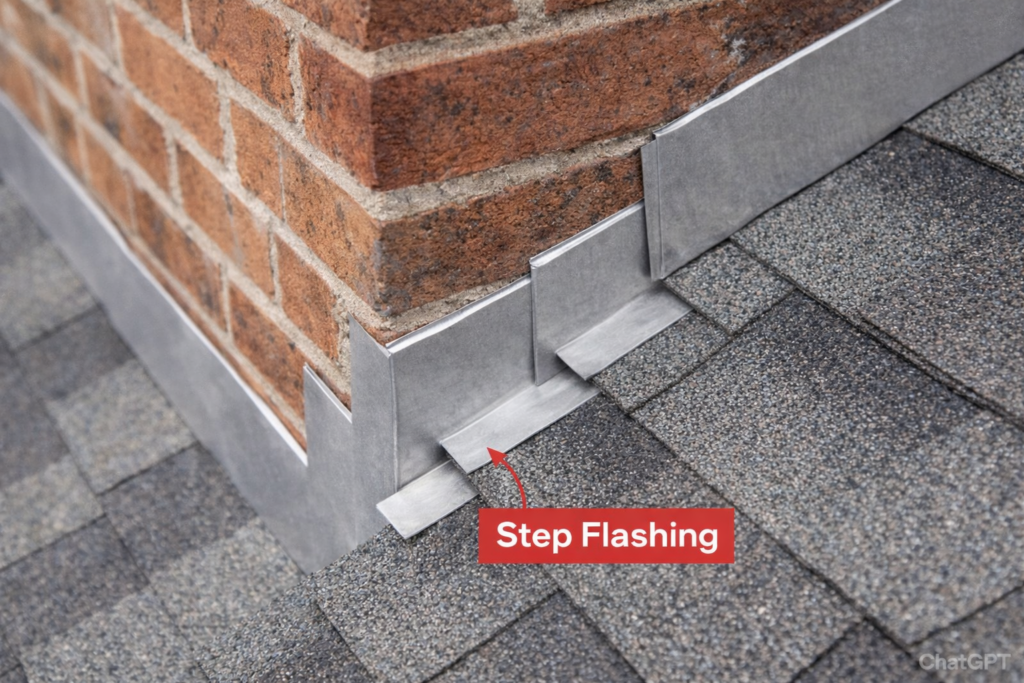
In almost all cases, flashing goes under the shingles. For example, step flashing, used along walls and the sides of chimneys, is woven between shingle courses. Each L-shaped piece sits on one shingle and beneath the next, creating a layered, staggered barrier. Water running down the adjacent wall is directed onto the shingle below and safely off the roof. The exception is counter flashing, the visible piece on a chimney, which is set into a mortar joint and bends down over the step flashing.
Pipe boot flashings, the collars around plumbing vents, are installed under the shingles on the uphill side and over them on the downhill side. This prevents water from catching the leading edge and lifting it. If you see flashing sitting on top of shingles with caulk as the primary seal, it’s a sign of improper installation. Sealant is a supplement, not a substitute for mechanical integration.
Different areas of your roof require a specific, integrated system of flashing. In the V-shaped channels where two roof slopes converge, valley flashing carries a significant volume of water, especially during heavy rain and snowmelt. Open metal valleys are common in our climate because they allow ice and debris to clear more easily. Along the eaves and rakes of your roof, drip edge is a simple but vital piece of metal that directs water into the gutter instead of letting it rot the fascia boards.
On chimneys wider than 30 inches, a chimney cricket is essential. This small, peaked structure is built behind the chimney to shed water around it, preventing water and debris from pooling against the back flashing joint, a common failure point. A properly flashed skylight also requires its own system of step and apron flashing, often from a manufacturer-supplied kit.
Signs Your Flashing May Be Failing
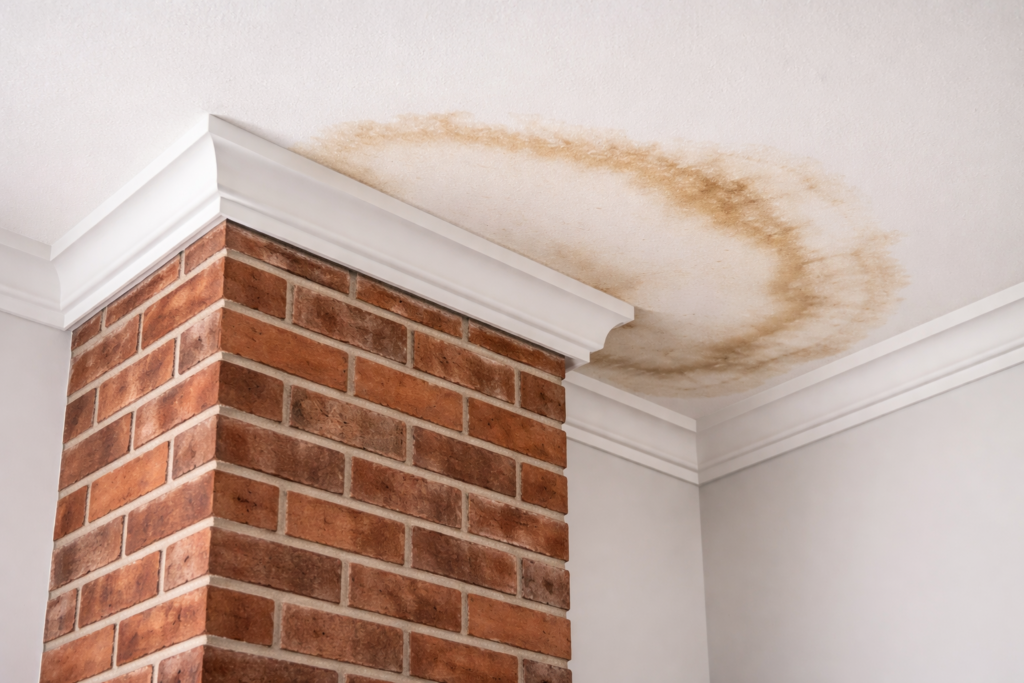
Flashing problems aren’t always obvious. The most common indicator is water staining on interior ceilings or walls, especially near a chimney, skylight, or dormer. From the ground, look for rust streaks on siding or brick, or use binoculars to spot gaps or lifting sections of metal.
In Northeast Ohio, flashing often fails before the shingles do. On homes 20+ years old, hundreds of freeze-thaw cycles have worked the metal loose, creating hidden entry points for water.
Northeast Ohio’s freeze-thaw cycle creates a specific pattern of deterioration. Water enters small gaps, freezes, expands, and progressively works the flashing loose. Homes in Rocky River, Westlake, and Strongsville built 20, 30, or even 40 years ago have endured hundreds of these cycles. On these homes, the original flashing is often the first part of the roof system to require attention.
Understanding Flashing Repair Costs
For an isolated repair, like a failed pipe boot or a small section of step flashing, a cost of around $500 is a reasonable range. A complete chimney re-flashing, however, typically runs between $500 and $1,500, depending on the chimney’s size and the scope of work. (For larger projects, we offer financing options.)
The more useful question is what a quote actually includes. A low bid might only cover surface caulking, a temporary patch that will fail again. A proper repair involves removing shingles, installing new, integrated flashing, and addressing any underlying rot. A trustworthy contractor will explain exactly what they are doing and why it provides a permanent solution. The cost of a proper repair is a fraction of the cost of fixing the interior water damage that results from a recurring leak.
A low-cost flashing repair quote often means a temporary patch. A proper, permanent fix involves replacing the metal and integrating it correctly with the roofing system.
Protect Your Home with an Expert Assessment
Your roof is a system, and flashing is one of its most critical components. If you’ve noticed water stains, are concerned about the age of your roof, or simply want an honest assessment, don’t wait for a small issue to become a major problem. Contact Peak & Valley Roofing today. We provide thorough inspections and clear, expert guidance for homeowners throughout Northeast Ohio.
Frequently Asked Questions
What is roof flashing and why does my roof need it?
It’s thin metal sheeting installed at your roof’s joints and edges to prevent water intrusion. Without it, your roof is vulnerable to leaks at every chimney, wall, and vent.
How does roof flashing work?
Flashing is layered with the shingles to create a waterproof barrier that directs water downhill and off the roof. It relies on proper integration, not just sealant, to work effectively.
Does flashing go over or under shingles?
In almost all cases, it goes under the shingles. Flashing is woven into the shingle layers. If you see flashing sitting on top of shingles sealed only with caulk, it’s likely installed incorrectly.
What are the different types of roof flashing?
Common types include step flashing (for walls), counter flashing (for chimneys), valley flashing (for roof intersections), drip edge (for eaves), and pipe boots (for vents). Each is designed for a specific transition point.
Is $500 expensive for a flashing repair?
It depends entirely on the scope of work. A simple pipe boot repair might be under $500, while a full chimney re-flashing can cost $1,500+. The true value is in doing the job right, not just applying a temporary patch.
How long does roof flashing typically last?
Standard galvanized steel lasts 15-30 years, while copper can last over 50. In Northeast Ohio, freeze-thaw cycles can shorten this lifespan, making regular inspections on homes over 20 years old essential.
Can flashing fail even when the shingles look fine?
Yes. This is a common source of leaks. The shingles can be perfectly intact, but if the flashing at a joint or penetration fails, water will find its way in. It’s often the first component to investigate for leaks.
Should flashing be replaced during a full roof replacement?
Absolutely. A full roof replacement is the best and most cost-effective time to replace all flashing. Reusing old flashing is a shortcut that compromises the integrity of your new roof.