
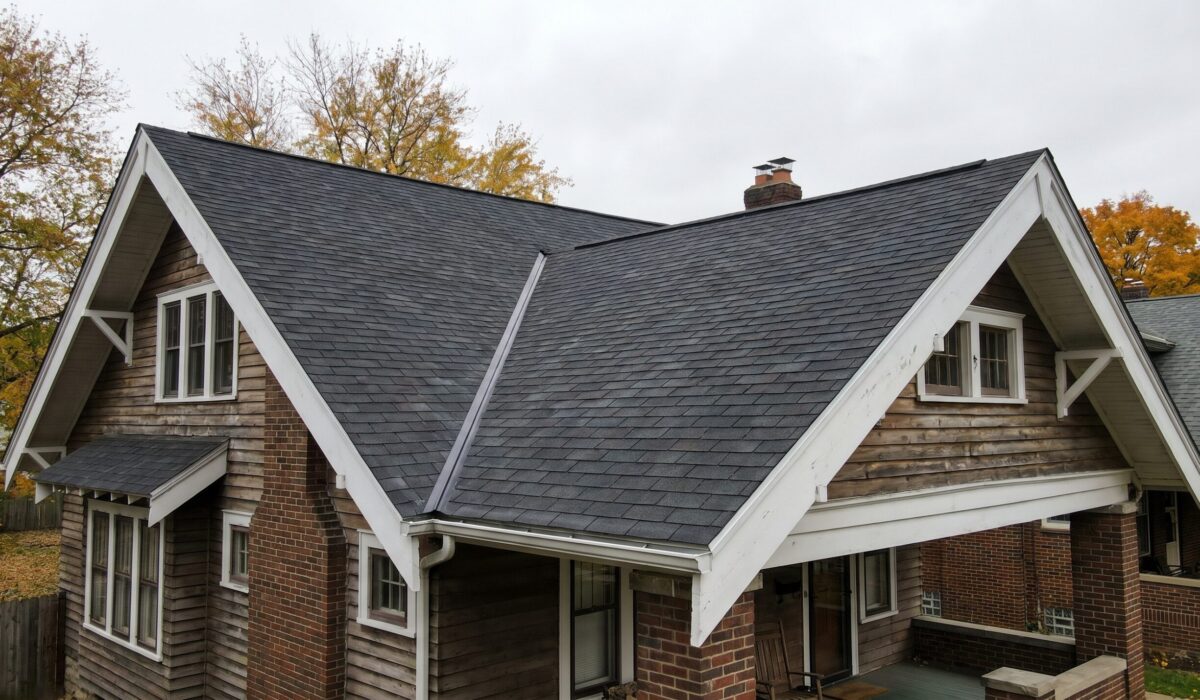
Understanding your roof’s edge components can save you thousands in water damage repairs. Drip edge is a metal flashing installed along roof edges to direct water away from fascia boards and prevent moisture intrusion, while rake edge refers to the sloped gable edge of your roof where specialized flashing protects against wind-driven rain.
For Rocky River homeowners dealing with Lake Erie’s harsh weather conditions, proper roof edge protection becomes even more critical. The combination of heavy snow loads, ice dams, and wind-driven rain can quickly exploit any weakness in your roof’s edge system.
Key Insight: Building codes require drip edge installation at both eaves and rakes, making it essential for code compliance and long-term roof protection.
In this guide, you’ll learn the key differences between eaves and rakes, understand various drip edge types, and discover when professional installation becomes necessary for your Rocky River home.
What is a roof drip edge
A roof drip edge is a metal flashing strip installed along the edges of your roof to direct water away from fascia boards and into gutters. This L-shaped or angled piece of metal creates a barrier that prevents water from seeping behind your roof’s edge components.
Most drip edges are made from aluminum, galvanized steel, or copper. Aluminum offers the best balance of durability and affordability for most homeowners, while copper provides premium longevity at a higher cost. The metal extends beyond the roof edge by about half an inch, creating a drip point that guides water into gutters rather than allowing it to run down fascia boards.
Modern building codes require drip edge installation at both eaves and gables (rakes). This requirement exists because water infiltration at roof edges causes some of the most expensive structural damage homeowners face. Without proper drip edge, water can penetrate behind fascia boards, leading to rot, mold, and compromised structural integrity of the roof deck.
The specific requirement comes from IRC Section R905.2.8.5, which mandates drip edge on shingle roofs with defined dimensions: the flange must extend at least 2 inches onto the roof sheathing and project at least 1/4 inch beyond the fascia board or sheathing edge. Adjacent drip edge sections must overlap by at least 2 inches, and the material must be minimum 26-gauge galvanized steel, aluminum, or an equivalent corrosion-resistant metal.
Without a drip edge, water follows a natural but destructive path. It can curl back underneath shingles through capillary action, the same effect that causes water to creep up a paper towel. Drip edge breaks that surface tension, forcing water to drip cleanly away from the house instead of wicking back toward the fascia.
The primary functions include protecting your roof deck from moisture, preventing water from getting behind fascia boards, and ensuring proper water flow into your gutter system.
Understanding rake edges and roof terminology
The rake edge refers to the sloped edge of a gable roof that runs from the eave up to the ridge. Unlike eaves, which are horizontal, rake edges follow the roof’s pitch and require different protection strategies.

What is an eave: The horizontal lower edge where your roof meets the exterior wall. This is where gutters typically attach and where most water collection occurs during normal rainfall.
What is a rake: The sloped edge at the gable end of your roof. This area faces different weather challenges, particularly wind-driven rain that can force moisture under shingles.
What is fascia: The vertical board running along the eaves and sometimes rakes. Fascia provides a mounting surface for gutters and helps create a finished appearance, but it’s vulnerable to water damage without proper drip edge protection.
The key difference between eaves and rakes lies in their orientation and water management needs. Eaves handle gravity-fed water flow, while rakes must deflect wind-driven moisture that approaches from multiple angles.
Drip edge vs rake edge explained
The confusion around “drip edge vs rake edge” stems from mixing component names with location descriptions. Drip edge is a type of metal flashing, while rake edge describes a roof location where that flashing gets installed.
At rake edges, you’ll often see “rake drip edge flashing” or “rake edge flashing” installed. This is simply drip edge designed for the sloped gable area. The functional differences become important during installation and performance.
At eaves, drip edge helps guide water into gutters and protects horizontal fascia boards from moisture infiltration. The installation sequence places drip edge under the underlayment at eaves.
At rakes, the same flashing protects shingle edges and roof decking from wind-driven rain while shedding water away from gable trim or rake boards. However, installation at rakes requires placing the drip edge over the underlayment.
Installation Tip: The underlayment sequence differs between eaves and rakes – under at eaves, over at rakes – to maintain proper water shedding in both locations.
Understanding this difference helps explain why professional installation matters. Incorrect sequencing can create water entry points that defeat the entire purpose of drip edge protection.
Types of roof drip edge and materials
Different drip edge profiles serve specific purposes, and choosing the right type depends on your roof design and local weather conditions.
| Type | Profile | Best Use | Key Benefit |
|---|---|---|---|
| D-Style | Wide drip area | Shingle roofs | Maximum water kickout |
| F-Style | Extended coverage | Heavy rain areas | Extra fascia protection |
| L-Style | Simple 90-degree | Basic applications | Cost-effective option |
D-Style (T-Style) drip edge features a wider drip area that kicks water further from the building. This type works well with dimensional shingles and provides excellent protection in areas with heavy rainfall like Rocky River.
F-Style drip edge offers an extended leading edge that provides additional coverage over fascia boards. This style works particularly well when you need extra protection from wind-driven rain or when fascia boards are especially vulnerable.
L-Style drip edge provides a simple 90-degree angle design that works for basic applications where standard protection is sufficient.
Material choices affect both performance and longevity. Aluminum resists corrosion and stays lightweight, making it ideal for most residential applications. Galvanized steel offers superior strength but may rust over time in coastal areas. Copper provides the longest lifespan but costs significantly more upfront.
Major shingle manufacturers require drip edges in their installation guidelines. Owens Corning and GAF both specify drip edge as a condition of their product warranties, and skipping it can void coverage entirely, regardless of shingle quality.
Some homes with prebent aluminum fascia or specialized rake molding may already have adequate edge protection built in, since the fascia itself directs water properly. A qualified roofer can assess whether existing trim meets current standards or needs a proper drip edge added.

Signs Your Drip Edge Needs Attention
Even properly installed drip edges deteriorate over time, especially under Lake Erie’s freeze-thaw cycles. Watch for these warning signs:
- Water staining or streaking on exterior walls below the roofline, instead of water flowing cleanly into the gutters
- Soft spots, discoloration, or peeling paint on fascia boards
- Visible mold growth near the roofline
- Interior ceiling stains near exterior walls, which can trace back to compromised drip edge working in combination with other roof edge issues
If you’re planning a roof replacement anyway, that’s the ideal time to correct any missing or improperly installed drip edge. Make sure your contractor’s written estimate specifies the drip edge type and dimensions they’ll use rather than treating it as an assumed line item.
Options if your roof lacks proper drip edge
| Solution | Best For | Typical Cost Range |
|---|---|---|
| Retrofit installation | Newer roofs in good condition | $3-8 per linear foot |
| Full replacement | During a full re-roofing project | $5-12 per linear foot |
| Repair existing | Minor damage or improper installation | $2-5 per linear foot |
Retrofitting a drip edge onto a newer roof without a full tear-off is possible but delicate. It involves carefully lifting the first course of shingles, removing old nails, and sliding new drip edges into place, work that’s best left to a professional to avoid shingle damage or voiding a warranty.
Professional drip edge services in Rocky River
Rocky River’s proximity to Lake Erie creates unique challenges for roof edge protection. The combination of lake-effect snow, freeze-thaw cycles, and wind-driven precipitation demands properly installed drip edge systems that can handle these conditions year-round.
Our drip edge services include:
– Complete roof edge inspections focusing on eaves and rakes
– Drip edge installation during roof replacement projects
– Correcting improperly installed or missing drip edge from previous work
– Storm damage assessment and insurance claim assistance
– Emergency repairs for compromised roof edges
Weather Reality: Lake Erie’s weather patterns can drive moisture horizontally into roof edges that lack proper protection, making quality installation crucial for long-term performance.
Many Rocky River homes built before modern building codes lack adequate drip edge protection during roof replacement. During roof replacement, we ensure all edges meet current code requirements while addressing any existing water damage to fascia or roof decking.
Peak and Valley Roofing brings extensive experience working with Northeast Ohio’s challenging weather conditions. As a family-owned company specializing in insurance restoration, we understand how proper drip edge installation protects your home and ensures your insurance coverage remains intact.
Common problems we address include missing drip edge at rakes, poor overlap joints that create leak points, and drip edge nailed into fascia instead of roof decking. These installation errors can compromise your entire roof system’s water management.
When you notice water stains on soffit or fascia, peeling paint along roof edges, or visible gaps between drip edge and fascia, it’s time for professional evaluation. Our team provides honest, no-pressure assessments and practical solutions that protect your investment without unnecessary upselling.
For reliable drip edge installation and roof edge protection in Rocky River and the greater Cleveland area, contact Peak and Valley Roofing for your free inspection and estimate.