

To find out how many roof turbines you need, you’ll use the standard attic ventilation rules and your attic’s size. Most homes need roughly 1 roof turbine for every 300-400 square feet of attic space, depending on vent size and code requirements.
Proper attic ventilation prevents heat buildup, reduces energy bills, and extends your roof’s lifespan. This is especially important in Northeast Ohio, where our climate swings from hot, humid summers to cold, snowy winters create unique ventilation challenges. This guide shows you the exact formula, step-by-step examples, and the key factors that might mean you need more or fewer turbines than average.
Quick Answer: Use the 1:150 rule (1 sq ft of ventilation per 150 sq ft of attic space) or 1:300 if you have a vapor barrier. Split this 50/50 between intake and exhaust vents.
What are roof turbine vents and why use them?
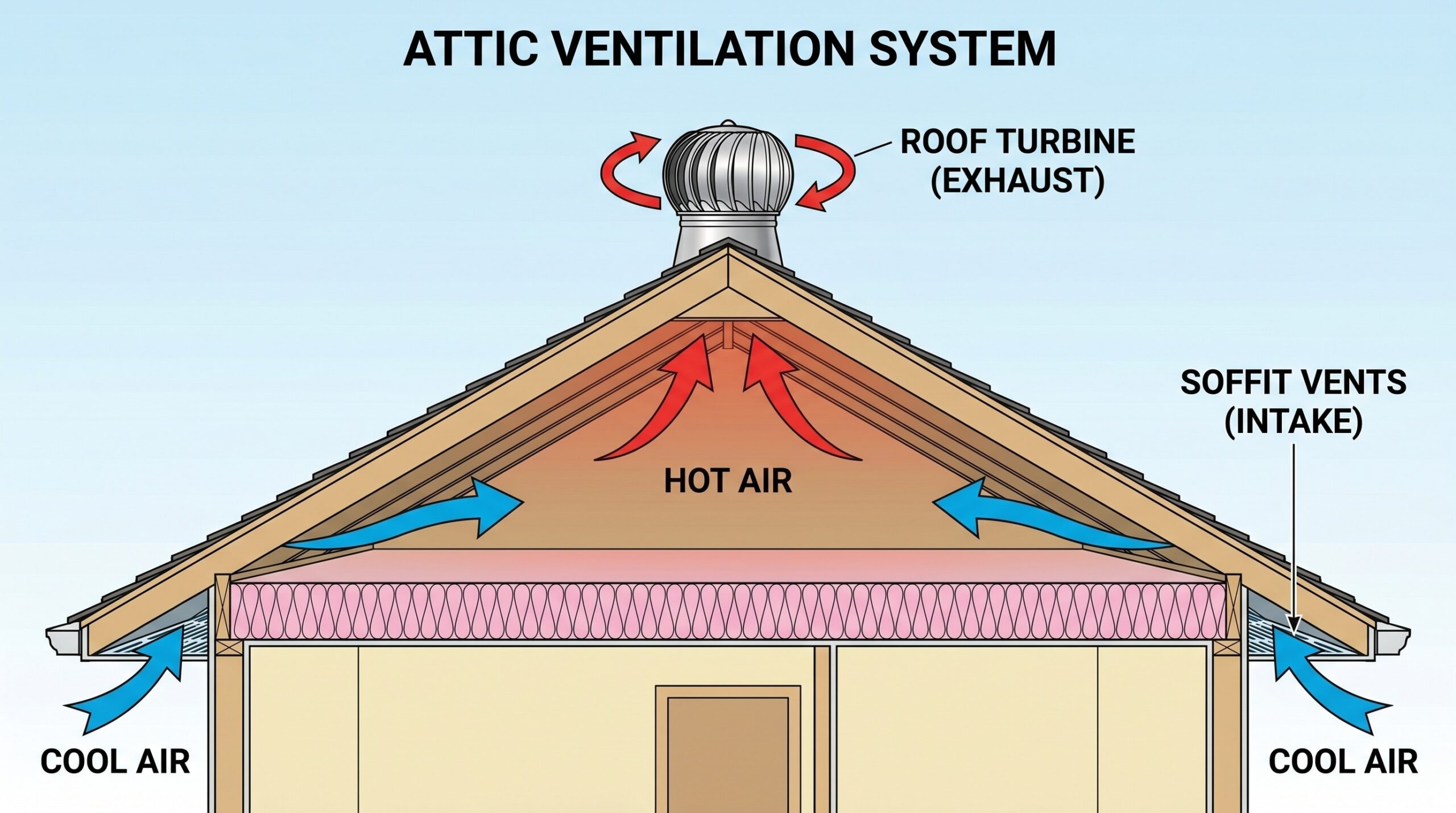
Roof turbines, also known as whirlybirds, are wind-powered exhaust vents that pull hot air from your attic. They work by spinning in the wind to create a low-pressure zone that draws warm air upward and out of your home.
These vents operate without electricity and provide continuous ventilation when there’s wind or thermal convection from attic heat. They’re particularly effective on hip roofs where ridge space is limited for other vent types.
The main benefits include removing excess heat that can reach 150°F in summer, preventing ice dams in winter, and helping your HVAC system operate more efficiently. In the Cleveland area, where we experience both sweltering summers and harsh winters, proper attic ventilation is crucial for year-round comfort and energy efficiency. Without proper ventilation, your attic becomes an oven that forces your cooling system to work harder.
Attic ventilation rules you need to know
The foundation of calculating turbine needs comes from two industry-standard rules established by building codes and roofing authorities.
The 1:150 Rule requires 1 square foot of net free ventilation area for every 150 square feet of attic floor space. This is the standard requirement for most homes without special conditions.
The 1:300 Exception allows you to use half the ventilation (1 square foot per 300 square feet) if you have a vapor barrier installed or if half your ventilation is at least 3 feet above the eaves.
Net Free Area (NFA) measures the actual open space through which air can pass. A typical 12-inch turbine provides about 150 square inches of NFA, though this varies by manufacturer and design.
Important: Always split your total ventilation 50/50 between intake vents (soffit or eave vents) and exhaust vents (turbines). This balance is crucial for proper airflow.
Step-by-step calculation method
Here’s the exact process to determine how many roof turbines your home needs.
Step 1: Measure your attic floor area. Multiply length times width. For example, a 40 ft × 30 ft attic equals 1,200 square feet.
Step 2: Apply the ventilation rule. Using the 1:150 rule, divide 1,200 ÷ 150 = 8 square feet of total ventilation needed.
Step 3: Calculate exhaust requirements. Since you need 50% exhaust, divide by 2: 8 ÷ 2 = 4 square feet of exhaust ventilation.
Step 4: Convert to square inches. Multiply by 144: 4 × 144 = 576 square inches of exhaust area needed.
Step 5: Divide by turbine NFA. If your 12-inch turbines provide 150 square inches each, then 576 ÷ 150 = 3.84, which rounds up to 4 turbines.
This calculation works for most standard installations, but several factors can change your requirements.
Key factors that change your turbine needs
Your specific situation might require adjustments to the basic calculation based on these important variables.
Roof pitch affects attic volume. Steeper roofs create more attic space above the insulation level. For pitches between 7:12 and 10:12, add 20% to your calculations. For 11:12 or steeper, add 30%.
Climate and wind patterns matter significantly. In Northeast Ohio, our humid summers and variable wind patterns can affect turbine performance. The Cleveland area’s proximity to Lake Erie creates unique weather conditions that may require additional ventilation beyond code minimums. Areas with consistently low wind speeds might require more turbines since wind-driven models perform better with steady airflow.
Existing ventilation impacts your needs. Check your current intake vents first. Turbines only work effectively with adequate soffit or gable vents to allow fresh air entry. Without proper intake, adding more turbines won’t improve performance.
Vapor barriers change the rules. If your attic has a properly installed vapor barrier, you can often use the 1:300 rule instead of 1:150, reducing the number of turbines needed by half.
Pro Tip: Never mix ridge vents with turbines on the same roof section. This creates air short-circuiting where the ridge vent pulls air from the turbine instead of the soffit vents.

Turbines versus other ventilation options
Understanding how turbines compare to other exhaust methods helps you make the right choice for your specific situation.
| Vent Type | Effectiveness | Cost Range | Best For | Key Limitation |
|---|---|---|---|---|
| Roof Turbines | Moderate-High | $30-$75 each | Hip roofs, windy areas | Wind-dependent performance |
| Ridge Vents | High | $400-$800 total | Long ridge lines | Needs full ridge installation |
| Static Box Vents | Moderate | $15-$40 each | Budget installations | Less airflow per unit |
| Powered Fans | Very High | $100-$600 each | Low-wind areas | Requires electricity, noise |
Turbines work best when you have consistent wind patterns and limited ridge space for continuous vents. They’re also ideal if you want passive operation without electrical costs or noise concerns.
Ridge vents typically provide the most uniform airflow but require installation along the entire ridge line. Static vents are the most economical but may require more units to achieve the same airflow as turbines.
For large attics or areas with minimal wind, combining different vent types or choosing powered options might provide better results than turbines alone.
The right choice depends on your roof design, local climate, and budget. Most homeowners in the Rocky River and Cleveland area find turbines offer the best balance of performance and cost for typical residential applications.
Remember to always verify your calculations against local building codes and consider consulting with a roofing professional for complex installations or unusual roof configurations. Proper sizing and installation ensure your ventilation system protects your home effectively for years to come.