
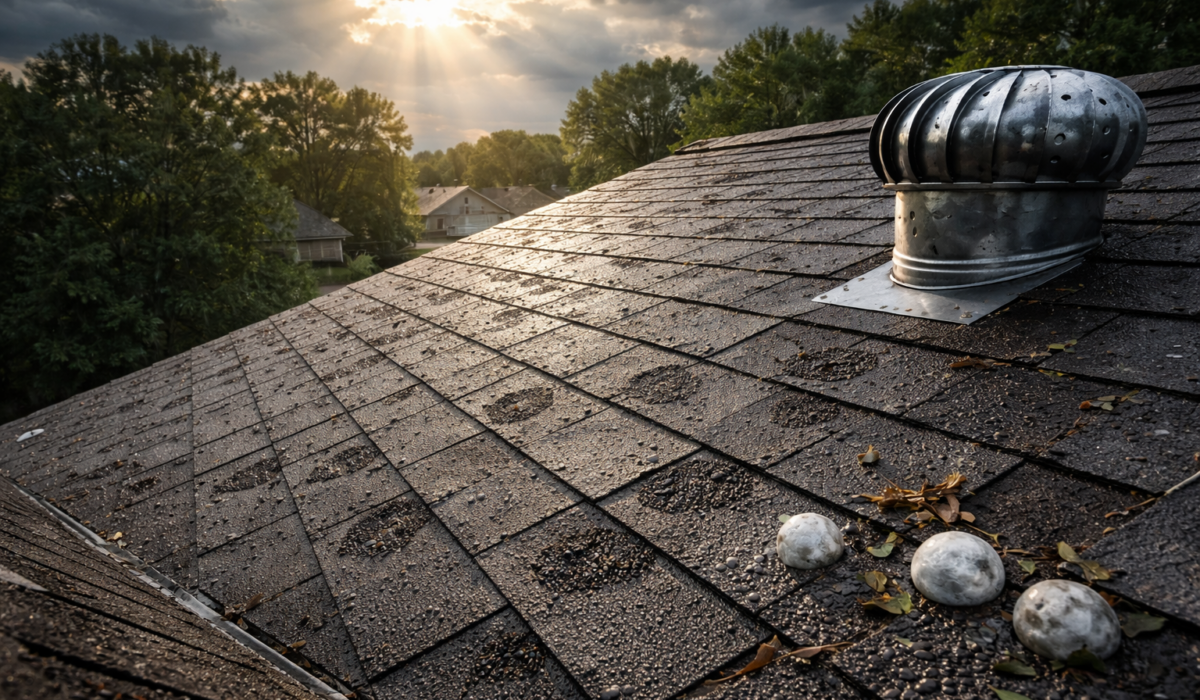
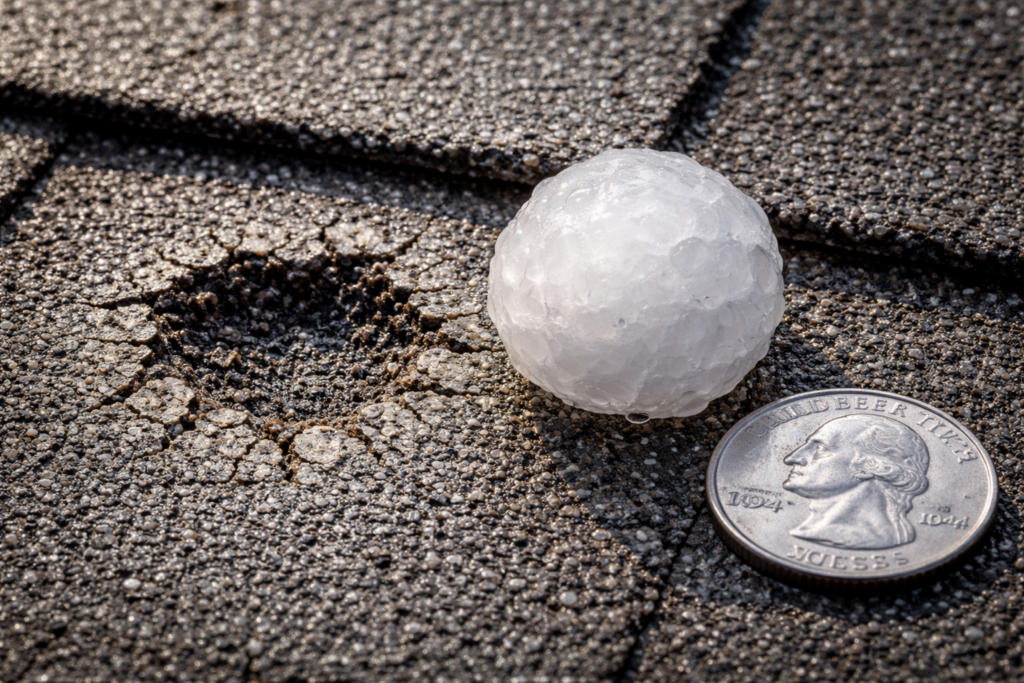
Hail damage occurs when ice pellets strike your roof hard enough to remove protective granules, create bruises or dents, and potentially cause cracks that lead to leaks. Quarter-sized hail (1 inch) or larger typically warrants professional inspection and a potential insurance claim. The signs typically include dark spots where granules are missing, soft areas on shingles, dented vents and flashing, and granule accumulation in gutters.
What Does Hail Actually Do to Your Roof?
When hailstones fall from Northeast Ohio storm clouds, they’re frozen projectiles reaching speeds over 100 mph. Hail forms when raindrops cycle through freezing layers of atmosphere, building into ice balls from pea-sized to softball-sized. The damage depends on stone size, wind speed, impact angle, and your roof’s age.
Quarter-sized hail is where most asphalt shingles start showing damage. Ping-pong ball sizes or larger raises serious concern golf ball-sized stones damage even impact-resistant shingles, while baseball-sized hail can penetrate roof layers entirely. Your roof’s age amplifies its vulnerability. Asphalt shingles bruise like an apple, creating soft spots. Metal roofing dents but holds up structurally. Wood shakes split along the grain, while clay and concrete tiles crack or shatter. Older roofs face higher risk because shingles lose flexibility over time.
Identifying Hail Damage on Asphalt Shingle Roofs
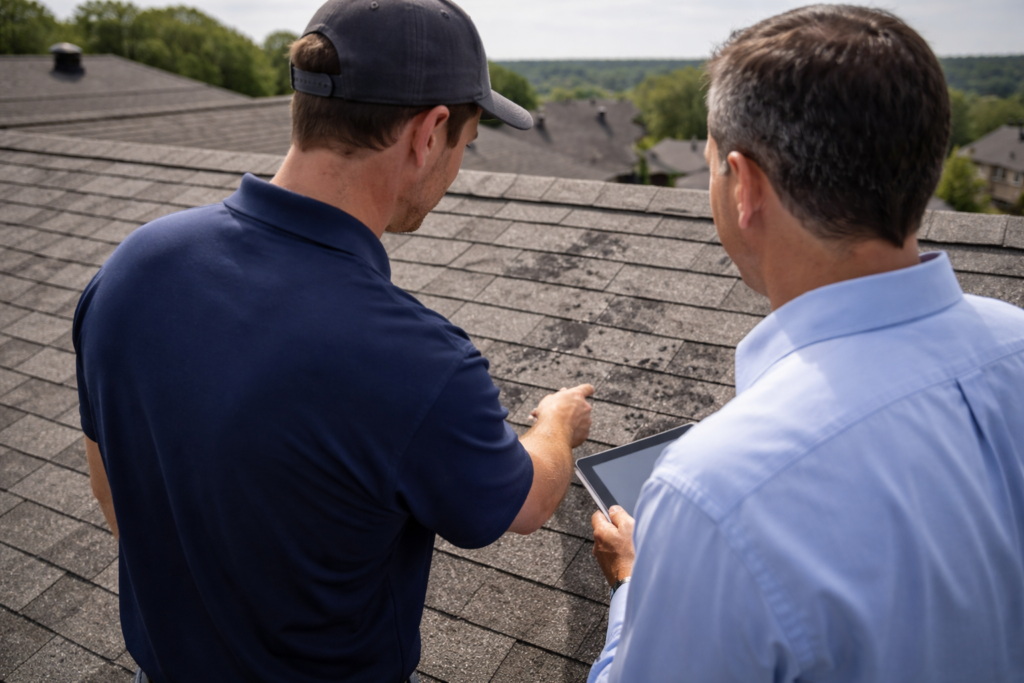
The most common sign of hail damage is granule loss. When hail hits hard enough, it knocks granules loose, exposing the black asphalt underneath. Fresh damage appears as dark circular marks scattered randomly across the roof. Check your gutters after a hailstorm for sudden granule accumulation appearing as dark, sand-like material.
Warning: Don’t climb onto your roof unless you have proper equipment and experience.
Bruising is damage you feel rather than see. Hail can compress the shingle without removing granules, creating soft, weakened areas that give under light pressure and may not bounce back. Insurance adjusters check for these bruised spots because they indicate functional damage even when the surface looks acceptable. Cracks occur when hail breaks through the shingle’s coating and fiberglass mat. Fresh cracks appear sharp-edged, often brown or orange at the break point.
The damage patterns also matter. Hail strikes randomly based on wind and storm movement. If you see damage concentrated on one slope or in neat rows, that’s not hail. True hail damage appears scattered and irregular across different roof areas.
The Insurance Claims Process for Hail Damage
Most homeowners insurance covers hail damage under standard dwelling coverage, but the timing matters. Most policies require damage reporting within 30-60 days of the storm. Some carriers limit claims filed more than a year after the hail event. Prompt action protects your rights and prevents arguments about when damage occurred.
Your policy type determines the eventual payout. Replacement Cost Value (RCV) policies pay to replace your damaged roof with a new comparable version minus your deductible. The insurer typically issues an initial check for depreciated value and holds back recoverable depreciation until you complete repairs. Actual Cash Value (ACV) policies only pay the depreciated value, which rarely covers full replacement on roofs over ten years old. Photograph your roof in good condition before storms to prove visible damage resulted from the recent event.
Note: You should always have an experienced roofing contractor present during the adjuster’s inspection. Adjusters work for the insurance company and may overlook damage.
Northeast Ohio Hail Patterns and Risk
Northeast Ohio experiences distinct hail risk related to geography and weather systems. Hailstorms occur most frequently during spring and early summer when warm, moist air meets cooler systems moving across the Great Lakes. May through July represents peak season, though severe storms can develop from April through September. Lake Erie’s influence affects storm intensity, temperature differences between lake water and land create conditions favorable for severe thunderstorm development.
Older suburban housing stock in Rocky River, Westlake, Strongsville, and Brunswick typically features asphalt shingles on roofs at least ten years old. These neighborhoods see higher damage rates because roofing materials have aged to the point where impact resistance has decreased. Recent storms in Northeast Ohio have produced stones from marble-sized to golf ball-sized, while softball-sized hail makes headlines, quarter-sized to golf ball-sized represents the typical severe threat here.
Why Quick Action Matters After Hail Storms
Damaged shingles don’t improve with time. Granule loss exposes asphalt to UV radiation, accelerating deterioration. Bruised areas also become increasingly brittle as they’re exposed to temperature cycles. Then water intrusion begins before visible leaks appear. Compromised shingles allow moisture into underlayment and decking, creating conditions for mold and wood rot. By the time you notice ceiling stains, interior damage has begun.
Insurance claim deadlines are firm. Most policies require damage reporting within 30-60 days. Missing these deadlines can result in denied claims. For Northeast Ohio homeowners dealing with potential hail damage, Peak & Valley Roofing provides honest assessment and transparent guidance through the insurance claim process. Our experience with regional weather patterns and local insurance practices ensures you understand your roof’s condition and available options. Contact Peak & Valley Roofing today for a professional inspection that documents actual damage and explains what it means for your roof’s integrity.
Frequently Asked Questions
How do I know if my roof has hail damage?
Look for dented gutters and roof vents, granule accumulation in downspouts, dark circular spots on shingles where granules are missing, or soft areas when you gently press on shingles. Most damage isn’t visible from the ground, so professional inspection after quarter-sized hail or larger is recommended.
How long do I have to file a hail damage claim?
Most insurance policies require damage reporting within 30-60 days of the storm. Some carriers extend this to one year, but prompt reporting strengthens your claim. Check your policy for exact deadlines.
Can I just repair a few shingles instead of replacing the whole roof?
Repair versus replacement depends on damage extent, location, and your roof’s age. When damage affects more than 25-30% of the roof, replacement typically makes more sense. If impacts are widespread, replacement may be necessary because scattered damage compromises overall integrity.
How much does hail damage roof repair cost?
Repair costs range from $500 to $3,000 for limited damage. Full replacement typically costs $5,000 to $15,000 depending on roof size, materials, and damage extent. Insurance coverage significantly impacts out-of-pocket costs.
Will filing a hail damage claim raise my insurance rates?
Possibly, but not always. Weather-related claims are considered “Acts of God” and may not affect premiums the same way at-fault claims do. Some carriers don’t increase rates for storm damage. Others may raise rates for all policyholders in areas experiencing significant storm activity.
What’s the difference between hail damage and normal roof wear?
Hail damage appears as random impact marks with sharp edges, concentrated granule loss in spots, and bruising that occurred suddenly. Normal wear shows uniform granule loss across the entire roof, brittle cracking along natural stress lines, and gradual deterioration over years.