
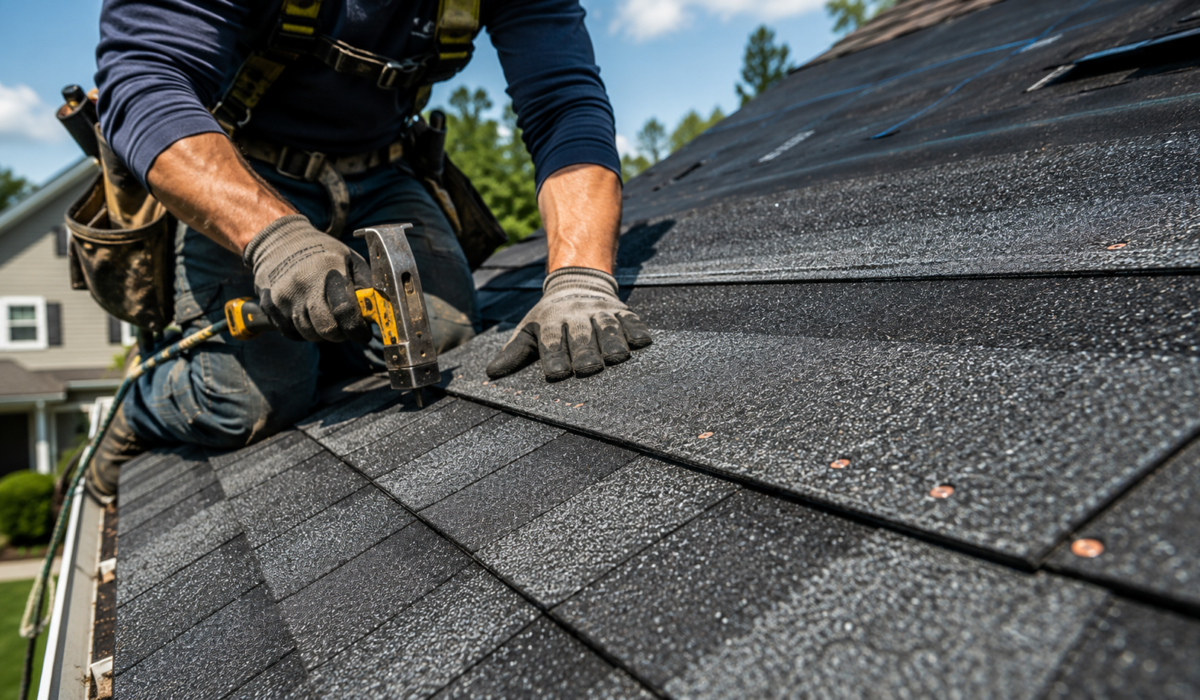
Impact-resistant shingles offer enhanced protection against the weather patterns common in our region. Understanding how these shingles work, what makes them different from standard materials, and whether they make financial sense for your home requires looking beyond marketing claims to actual construction differences and real-world performance.
What Exactly Are Impact-Resistant Shingles?
Impact-resistant shingles are roofing materials engineered to absorb and distribute impact force without sustaining damage. The construction differs significantly from standard asphalt shingles.
These shingles typically incorporate polymer-modified asphalt, specifically SBS rubber, which adds flexibility and resilience. The reinforced fiberglass mat provides additional structural strength. This combination allows the shingle to flex under impact rather than crack or fracture. The granule adhesion is also enhanced in impact-resistant products.
How is Impact Resistance Measured?

The UL 2218 standard provides the industry testing protocol for impact resistance. Underwriters Laboratories developed this test in 1996 to give homeowners a consistent way to compare products.
The test involves dropping steel balls of various sizes onto installed shingle samples. Each sample must withstand two impacts in the same spot without cracking or rupturing. The classification system runs from Class 1 through Class 4.
Class 1 through Class 4
Class 1 shingles withstand a 1.25-inch steel ball dropped from 12 feet. Class 2 requires surviving a 1.5-inch ball from 15 feet. Class 3 means the shingle can handle a 1.75-inch ball from 17 feet. Class 4 represents the highest protection level, requiring the shingle to withstand a 2-inch steel ball dropped from 20 feet without any visible damage.
That 2-inch steel ball creates impact force equivalent to hail traveling at roughly 90 miles per hour. Most roofing professionals and insurance companies consider Class 4 the gold standard for severe weather protection.
How to Verify a Shingle’s Impact Rating
Check the cellophane wrapper on the underside of the shingle bundle. Manufacturers print the impact rating directly on this wrapper. A Class 4 shingle will clearly state its UL 2218 Class 4 certification. In addition to this, you should also tick off the following verifications:
- Review the product specifications sheet before purchase. Reputable manufacturers provide detailed documentation showing test results and certification numbers.
- During installation, inspect the reinforcing mat on the underside of a shingle sample. The fiberglass backing should be thicker and denser than standard products.
Keep copies of product specifications, certification papers, and installation invoices showing the specific shingle model and its Class 4 rating.
Impact-Resistant Shingles and Insurance
Many insurance providers offer premium discounts for homes with Class 4 impact-resistant shingles. The discounts typically range from 10% to 35% depending on your insurance company and location.
Insurance companies recognize that impact-resistant roofing reduces claim frequency and payout amounts. A roof that withstands hail damage means fewer expensive replacement claims following storms. Contact your insurance provider before installation to confirm available discounts and any documentation requirements.
How Long Do Impact-Resistant Shingles Last?
Impact-resistant shingles typically last 25 to 35 years in Northeast Ohio’s climate. Standard asphalt shingles in the same conditions usually require replacement every 15 to 20 years.
The extended lifespan reflects superior durability across multiple categories. The polymer-modified asphalt maintains flexibility through freeze-thaw cycles rather than becoming brittle. Enhanced wind resistance, often rated to 130 mph, means fewer shingles get displaced during severe storms. Better granule retention protects the underlying asphalt from UV degradation over time.
Are Impact-Resistant Shingles Worth the Cost?
Finally, the important question is whether impact-resistant shingles (which typically cost 20% to 40% more than standard shingles) are worth the cost. The value calculation depends on factors specific to your situation. For homeowners planning to stay in their property for 10 years or more, the extended lifespan often justifies the upfront investment.
However, if you’re unsure of the right choice to make, Peak & Valley Roofing serves homeowners throughout Rocky River, Westlake, Strongsville, Brunswick, and surrounding Northeast Ohio communities. We provide solutions matched to your needs rather than unnecessary upgrades. Contact Peak & Valley today to discuss whether impact-resistant shingles make sense for your home and situation.
Frequently Asked Questions
Will impact-resistant shingles prevent all hail damage?
No roofing material is completely hail-proof. Extreme weather events with hail exceeding 2.5 inches can damage even Class 4 shingles. However, these shingles reduce damage from typical hail by 70% to 80% compared to standard materials.
Do impact-resistant shingles look different from standard shingles?
Impact-resistant shingles are available in the same styles, colors, and profiles as standard architectural shingles. The visual difference is imperceptible. The engineering differences are internal to the shingle construction.
How much can I save on insurance premiums with Class 4 shingles?
Most insurance providers offer discounts ranging from 10% to 35% on dwelling coverage for homes with Class 4 shingles. The exact discount depends on your insurance company and location. Contact your agent before installation to confirm available savings.
Can I install impact-resistant shingles on an older home?
Yes. Impact-resistant shingles can be installed on most existing roof structures. They are slightly heavier than standard shingles, but the weight difference rarely requires structural reinforcement. A professional evaluation can confirm your roof deck can support the materials.
Do impact-resistant shingles require special installation?
Impact-resistant shingles are installed using standard roofing practices, but proper installation is critical for warranty coverage and performance. Working with experienced contractors familiar with these materials ensures the roof performs as designed.