

Finding gritty, sand-like particles in your gutters or downspouts is a sign of roof granule loss. While some shedding is normal, significant loss means your shingles’ protective layer is gone, exposing your roof to UV rays, moisture, and Northeast Ohio’s harsh freeze-thaw cycles. Understanding the cause, whether it’s age, hail, or wear, is the first step toward preventing a minor issue from becoming a full roof replacement.
What Are Roof Granules and Why Do They Matter?
Look closely at an asphalt shingle, and you’ll see its rough, textured surface is made of embedded particles called granules. These aren’t decorative. They are your roof’s primary protective layer. Typically made of crushed rock or ceramic-coated minerals, granules serve a critical purpose. They block the UV rays that dry out and crack the asphalt beneath, provide essential fire resistance, and give the shingle its color.
Key Takeaway: Granules are not cosmetic. They are your roof’s functional, protective layer. When they are gone, so is your roof’s remaining service life.
Without this protective layer, the shingle’s asphalt core is left defenseless. Sun, rain, and temperature swings work directly on the material, accelerating its breakdown. Deterioration that would normally take years with intact granules can happen in a single season once they’re gone.
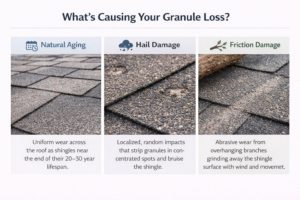

Understanding what caused the granule loss on your roof is key to determining the right response. Natural aging is the most common factor. As shingles approach the end of their 20 to 30-year lifespan, the bond securing the granules weakens and shedding accelerates. This is an expected sign that a roof replacement is on the horizon, not that something has gone wrong.
However, other factors can cause premature wear. In Northeast Ohio, hailstorms are a recurring reality, and their impact can strip granules in concentrated patches or across an entire slope. This sudden, localized damage is distinct from age-related wear and often qualifies for an insurance claim when properly documented.
A Note on Our Climate: In Northeast Ohio, hail and recurring freeze-thaw cycles are expected stressors that accelerate granule loss on any roof.
Friction from overhanging tree branches acts like sandpaper, slowly grinding away the shingle surface with every gust of wind. This is a common issue in established neighborhoods like Rocky River and Westlake with mature trees.
Improper installation can also compromise granule adhesion from day one, while pressure washing can strip the surface far too efficiently. Though less common, manufacturer defects can also cause premature shedding, making warranty documentation crucial.
What Does Granule Loss Look Like From the Ground?
You can often identify the warning signs of granule loss without ever leaving the ground. Stand back from your home and look for bald or shiny patches on the shingles, where the bare asphalt is visible. After a rain, check where your gutters drain. A deposit of coarse, dark grit at the base of a downspout is one of the clearest indicators.
The Easiest Sign to Spot: The clearest ground-level sign of granule loss is a gritty, sand-like deposit where your downspouts drain after a rainstorm.
A heavy, consistent layer of these granules in your gutters after every storm signals ongoing, accelerating loss. A roof in good condition should have a consistent color and texture. If yours has a patchwork appearance with smooth areas next to textured ones, it’s another visible sign that the protective layer is breaking down. These ground-level clues tell you something is happening. A professional inspection tells you how far it’s progressed.
Does Granule Loss Automatically Mean a New Roof?

The answer depends on the roof’s age, the extent of the loss, and the underlying cause. Widespread granule loss across multiple sections indicates a systemic breakdown, and spot repairs won’t solve the problem. On a roof that is 20 years old or older, significant granule loss is a clear sign it’s nearing the end of its designed lifespan. At that stage, patching a roof in overall decline rarely pays off, as the initial repair cost often turns into escalating costs when adjacent sections begin to fail.
However, if the granule loss is isolated to a few shingles on a roof under 15 years old, a targeted repair is often the most cost-effective approach. Replacing only the affected shingles restores protection without the expense of a full replacement. Storm damage operates under different rules. Hail-related granule loss may qualify for an insurance claim regardless of the roof’s age, provided it’s documented promptly.
How to Address Granule Loss
The correct approach depends on the scope of the damage. For isolated issues on an otherwise healthy roof, shingle replacement is the right solution. If an entire slope has sustained damage, a partial re-roof may be a reasonable option. This pattern sometimes occurs after a storm hits one side of a house harder than the other. When granule loss is widespread or the roof has reached its expected lifespan, a full roof replacement is the only way to restore complete protection and avoid the cycle of recurring repairs.
Important Note on DIY Fixes: Once granules are gone, they cannot be reapplied. DIY patch kits offer a temporary cosmetic fix at best and do not restore the shingle’s protective qualities.
Protecting Your Investment and Preventing Future Damage
While you can’t stop aging, you can slow its progression and catch problems before they compound. Annual inspections are the most effective step, allowing a professional to identify early-stage granule loss and storm damage while repairs are still a realistic option.
Simple maintenance makes a significant difference. Keep your gutters clean and monitor the volume of granules you find, as this is a useful indicator of wear. Trim any tree branches that make contact with the roof to prevent friction damage. If you notice algae or moss, opt for a professional soft-wash treatment. Both are common in Northeast Ohio’s humid summers, and a soft wash cleans the surface without stripping the protective granules. Finally, when it’s time for a replacement, choosing higher-grade, impact-resistant shingles provides durable protection against the specific demands of our climate.
Get a Clear Answer for Your Home
If you’re seeing the signs of granule loss on your Northeast Ohio home, understanding the extent of the issue is the critical next step. At Peak & Valley Roofing, we provide honest, thorough inspections to give you a clear picture of your roof’s health. Contact us today to schedule a professional assessment and get the answers you need to protect your home.
Error: Contact form not found.
Frequently Asked Questions
What causes granule loss on a roof?
The most common causes are natural aging, hail impact, and freeze-thaw cycles. Other factors include friction from tree branches, improper installation, and pressure washing.
What does granule loss look like?
Look for bald or shiny patches on shingles, gritty buildup near downspouts, heavy granule accumulation in gutters, and an uneven or patchy roof appearance.
Does granule loss mean I need a new roof?
Not always. Isolated loss on a younger roof can often be repaired. Widespread loss on an older roof typically signals that a replacement is the most sound course of action.
How do you fix granule loss on a roof?
Granules cannot be reapplied. The fix involves replacing the damaged shingles, re-roofing a damaged section, or a full roof replacement if the loss is widespread.
Is granule loss covered by homeowners insurance?
Only if caused by a specific storm event like hail. Age-related granule loss is considered normal wear and tear and is not covered.
How much granule loss is normal for a new roof?
A new roof will shed some excess granules from the manufacturing process in the first few months. If significant shedding continues or bald spots appear, it warrants an inspection.
How can I tell if granule loss is from hail or aging?
Hail damage often appears as scattered, random impact points. Age-related loss is more uniform and widespread as the entire surface weakens over time.