

If your attic feels like a furnace in summer or you’re battling ice dams during Cleveland’s harsh winters, poor ventilation is likely the culprit. Getting the right number of soffit vents can solve these expensive problems while keeping your energy bills in check throughout Northeast Ohio’s variable climate.
The answer depends on your attic size and follows simple building code ratios. For most homes, you’ll need 1 square foot of net free vent area for every 150 to 300 square feet of attic floor space, split evenly between intake (soffit) and exhaust (ridge or roof) vents. A typical 1,200 square foot attic needs about 576 square inches of soffit vent area using the standard 1:300 rule.
Quick Fact: Most building codes require balanced ventilation with roughly 50% intake vents at the soffits and 50% exhaust vents at the ridge or roof peak for optimal airflow.
Let’s walk through the exact calculations so you can determine your specific needs and avoid costly moisture damage or energy waste in your Rocky River or Cleveland area home.
Understanding the 1:150 and 1:300 ventilation rules
The building industry uses two main ratios to determine ventilation requirements. The 1:150 rule requires 1 square foot of net free vent area for every 150 square feet of attic floor space. This conservative approach works for most situations, especially older homes throughout Cleveland’s historic neighborhoods without proper air sealing.
The 1:300 rule allows you to cut ventilation requirements in half when your home has a vapor barrier and balanced intake-exhaust system. Under this rule, you need only 1 square foot of vent area per 300 square feet of attic space.
According to the International Residential Code, the 1:300 ratio applies when at least 40% of vents are intake vents near the eaves and the remaining area consists of exhaust vents in the upper third of the attic.
Most contractors in Northeast Ohio recommend starting with the 1:300 calculation for newer homes with good air sealing, then adjusting up to 1:150 if you notice moisture issues or live in an area prone to lake-effect snow and extreme temperature swings.
Measuring your attic and calculating total vent area
Start by measuring your attic floor area in square feet. For a rectangular attic, multiply length times width. An L-shaped attic requires adding the areas of each section together.
Here’s the basic math for both ratios:
– 1:300 ratio: Attic area ÷ 300 = total vent area needed (in square feet)
– 1:150 ratio: Attic area ÷ 150 = total vent area needed (in square feet)
Convert to square inches by multiplying your result by 144, since individual vents are rated in square inches of net free area.
Let’s say your attic measures 30 feet by 40 feet (1,200 square feet). Using the 1:300 rule: 1,200 ÷ 300 = 4 square feet of total vent area, or 576 square inches. The more conservative 1:150 rule would require 1,152 square inches.
Important: Always use the manufacturer’s net free area rating, not the physical vent size. A 4-inch round vent might only provide 12 square inches of actual airflow due to screens and louvers.

Splitting ventilation between intake and exhaust vents
Proper attic ventilation requires balanced airflow with cool air entering through soffit vents and warm air exiting through ridge or roof vents. The Fine Homebuilding guide recommends splitting your total vent area evenly.
For our 1,200 square foot attic example needing 576 square inches total, you’d want 288 square inches of soffit (intake) area and 288 square inches of ridge or roof (exhaust) area.
This balanced approach prevents short-circuiting where air enters and exits through the same area without flowing across the entire roof deck. Without proper balance, you might create negative pressure that pulls conditioned air from your living space.
| Attic Size | Total NFA (1:300) | Soffit NFA Needed | Exhaust NFA Needed |
|---|---|---|---|
| 1,000 sq ft | 480 sq in | 240 sq in | 240 sq in |
| 1,500 sq ft | 720 sq in | 360 sq in | 360 sq in |
| 2,000 sq ft | 960 sq in | 480 sq in | 480 sq in |
Converting vent area to actual vent counts and spacing
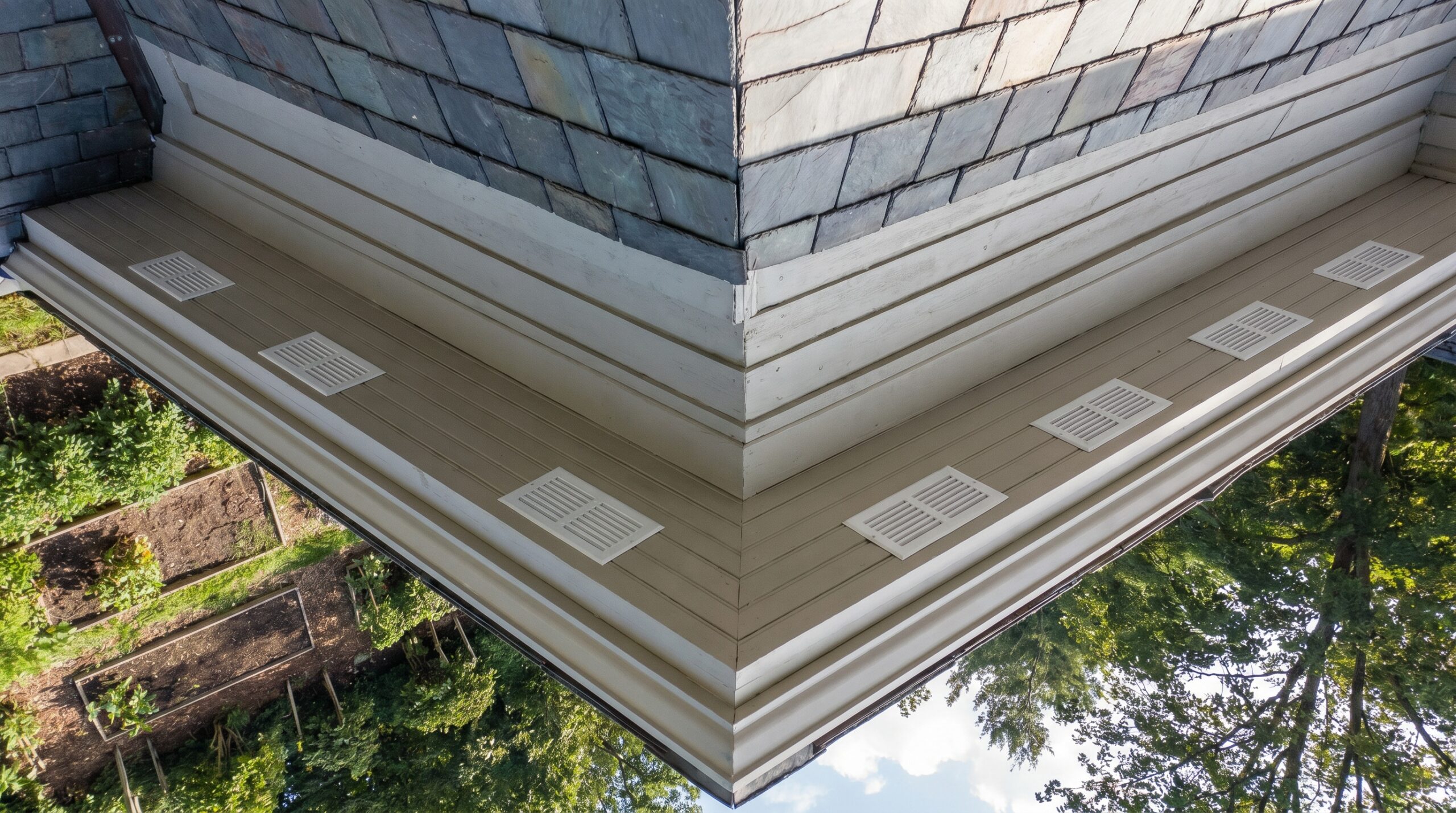
Now comes the practical part: turning your calculated area into real vents. Each soffit vent has a specific net free area rating. Common rectangular soffit vents provide 18-26 square inches each, while smaller round vents offer 8-15 square inches.
Using our example of needing 288 square inches of soffit area, you’d need about 12 vents if using 24-square-inch rectangular vents (288 ÷ 24 = 12 vents).
For spacing, measure your total soffit length and divide by the number of vents. A house with 80 feet of soffit perimeter and 12 vents would space them every 6.7 feet (80 ÷ 12 = 6.7 feet).
Most contractors in the Cleveland area space soffit vents every 4-8 feet for good distribution, adjusting based on the vent size and net free area. Remember to install baffles between each rafter to prevent insulation from blocking airflow.
Pro Tip: You can’t really have too many soffit vents as long as you maintain the 50/50 intake-exhaust balance. Extra intake capacity often improves performance during Northeast Ohio’s hot, humid summers.
The key to effective attic ventilation lies in proper calculation and balanced installation. Start with your attic measurements, choose the appropriate ratio based on your home’s construction, and ensure equal intake and exhaust areas. When in doubt, consult with a local roofing professional who can verify your calculations and recommend products that meet local building codes. Proper ventilation protects your roof investment and keeps your Rocky River or Cleveland area home comfortable year-round, especially during our challenging winter months.